
Understanding the Everyday Impact of Interest Rates
Interest rates are an often-overlooked but highly influential factor that shapes how much individuals pay or save each month. They affect a wide range of financial commitments, from home loans and personal financing to credit card balances and everyday expenses. While these changes may not always be immediately visible, they tend to build gradually, and the impact of interest rates often becomes clearer only as repayment patterns and financial pressures evolve.
Even a small adjustment, such as a 1 per cent increase, can lead to noticeable changes in repayment amounts. For households in Singapore, this can mean tighter monthly budgets, reduced disposable income, and the need to reassess spending priorities. These changes are particularly important for individuals managing multiple financial obligations at once.
In Singapore, interest rate movements are influenced by global economic conditions as well as the Monetary Authority of Singapore, which uses monetary policy to maintain price stability and support sustainable economic growth. As a result, local borrowing costs are closely tied to broader market trends, making it important for individuals to stay informed and prepared.
These shifts extend beyond major financial decisions. They influence everyday expenses such as car instalments, education loans, insurance premiums, and even business-related costs. When interest rates rise, borrowing becomes more expensive, which may slow spending. Conversely, when rates fall, borrowing becomes more accessible, often encouraging consumption and investment.
Ultimately, interest rates play a quiet but significant role in shaping financial habits. They influence how individuals borrow, plan, and prioritise their resources over time. This article explores how these changes affect both personal finances and lifestyle decisions, while offering practical insights on how borrowers in Singapore can adapt and stay financially resilient.
Key Takeaways
- Small changes in interest rates can lead to meaningful differences in loan repayments over time, affecting both short-term cash flow and long-term financial commitments.
- Rate movements are influenced by broader economic conditions, and understanding these drivers helps borrowers anticipate changes rather than react to them.
- Daily financial decisions, from spending habits to major purchases, are often shaped by changing borrowing costs, making it important to adjust plans proactively.
- Maintaining structured financial habits and working with a reliable lender can help borrowers manage repayment changes more confidently and sustain long-term financial stability.
The Basics Behind Interest Rates and Borrowing

Interest rates form the foundation of how borrowing works, yet many borrowers only notice them when repayments increase. By understanding what drives these changes and how they affect different types of loans, individuals can make more informed financial decisions and better prepare for shifts in their financial commitments.
Why Interest Rates Move: The Forces Behind the Numbers
Interest rates represent the cost of borrowing money and are influenced by central banks, financial institutions, and global economic conditions. In simple terms, they reflect how expensive it is to access credit at any given time, which directly shapes the impact of interest rates on both individuals and businesses.
In Singapore, the financial system operates under a unique exchange-rate-based framework, as guided by the Monetary Authority of Singapore, which aims to maintain price stability and sustainable economic growth. While this approach does not directly target interest rates, local lending rates still respond to global movements, particularly those influenced by major economies such as the United States. This explains why the impact of interest rates can shift even when domestic conditions remain stable.
When global interest rates rise, banks and licensed lenders in Singapore adjust their lending rates accordingly to maintain market equilibrium. These adjustments ensure that financial institutions remain aligned with broader funding costs and risk considerations, reinforcing the impact of interest rates across the lending environment.
Inflation, consumer demand, and government bond yields also influence how rates move. When inflation increases, authorities may tighten financial conditions to manage price levels, which raises borrowing costs and directly affects individuals and businesses.
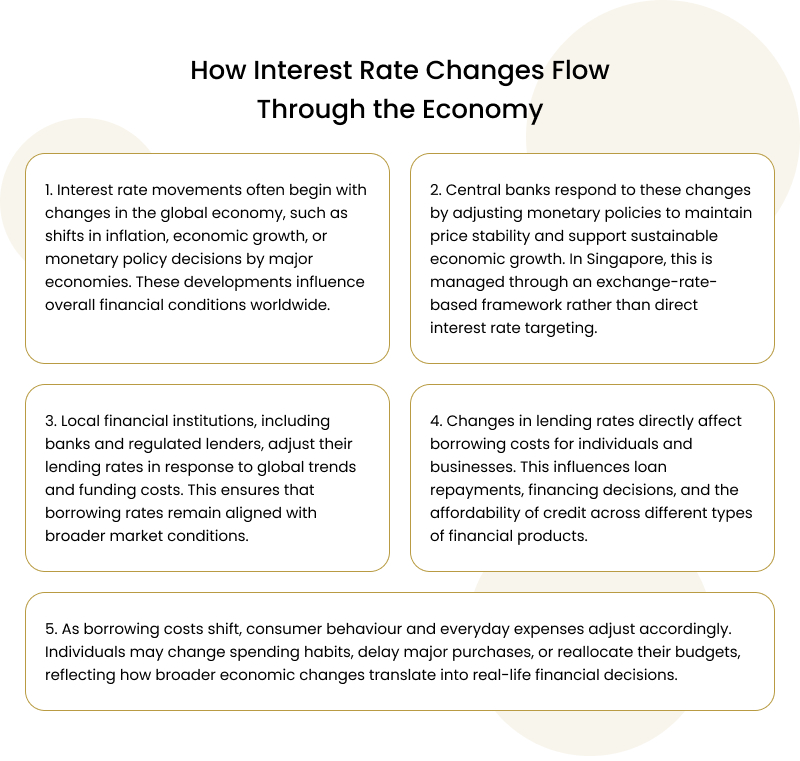
Understanding these mechanics helps borrowers recognise that loan pricing reflects broader economic conditions rather than being arbitrary. With stronger financial literacy, individuals are better equipped to interpret these changes and avoid being caught off guard by sudden repayment increases.
More importantly, understanding why rates move allows borrowers to anticipate repayment changes and make better refinancing or restructuring decisions. This further strengthens their ability to manage the impact of interest rates in a proactive and informed way.
How Small Rate Changes Affect Loan Repayments
Even small changes in interest rates can have a noticeable effect on loan repayments, especially over longer tenures. Understanding this helps borrowers see how seemingly minor adjustments can accumulate over time and influence overall financial commitments.
For example, a borrower with a $10,000 personal loan over three years at a 6 per cent interest rate may see manageable monthly repayments initially. If the rate increases to 7 per cent, the monthly instalment may rise modestly, but the total interest paid over the loan period increases more noticeably. This illustrates how small adjustments can accumulate over time, reinforcing the often overlooked impact of interest rates on overall repayment costs.
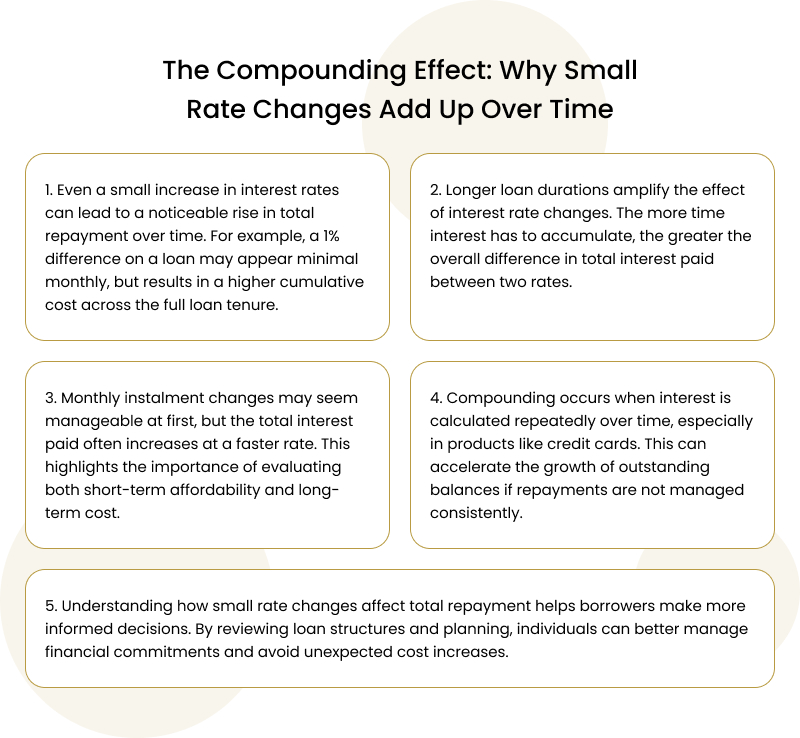
Even a 0.5 per cent rate increase can translate into hundreds of dollars more in annual repayments, depending on loan size and tenure. This is because interest compounds over time, amplifying the impact of interest rates beyond what borrowers may initially expect. To better understand how different interest calculations work, such as flat and effective rates, borrowers can refer to a detailed explanation of interest rate structures in Singapore.
For personal loans, higher rates can increase monthly instalments or extend repayment periods, reducing available cash for other expenses. This is particularly relevant for individuals who rely on a personal loan moneylender in Singapore for timely financial support.
Homeowners on floating-rate mortgages often experience immediate changes when benchmarks such as SORA are adjusted. These revisions can quickly raise monthly obligations, making the impact of interest rates more visible in day-to-day budgeting.
Credit card balances are even more sensitive due to compounding interest. A small increase can significantly raise outstanding balances over time, highlighting how the impact of interest rates can escalate when debts are not actively managed.
Borrowers with multiple financial commitments may face overlapping increases across different loans. This creates cumulative pressure, where the combined impact of interest rates becomes more difficult to manage without careful planning.
For individuals seeking short-term financial relief, options such as payday loans may provide quick access to funds. However, it remains important to assess repayment capacity carefully, as higher rates can increase total repayment obligations.
Businesses also respond to rising borrowing costs by adjusting prices, which contributes to broader economic inflation. This indirectly affects consumers, reinforcing how the impact of interest rates extends beyond loans into everyday expenses.
As a result, individuals may need to adjust their budgeting habits to maintain stability. Managing cash flow effectively becomes essential in adapting to changing repayment conditions while staying financially resilient.
The Lifestyle Ripple: How Interest Rates Shape Everyday Choices
Beyond loans, changes in interest rates also influence how individuals spend, save, and plan their daily lives, often in ways that are not immediately noticeable but become more significant as financial commitments and spending patterns adjust over time.
Rising interest rates tend to influence consumer behaviour by encouraging more cautious spending. Many individuals delay major purchases, reduce discretionary expenses, or prioritise debt repayment, reflecting the broader impact of interest rates on lifestyle decisions.
Lower rates, on the other hand, can encourage borrowing for planned expenses such as renovations, weddings, or vehicle purchases. While this can support short-term lifestyle improvements, it is important to consider long-term affordability as the impact of interest rates may change over time.
Housing decisions are also affected. Some individuals postpone upgrading their homes, while others adjust expectations by choosing smaller properties or longer loan tenures. These decisions illustrate how the impact of interest rates influences major financial commitments.
Higher loan costs can reduce disposable income, influencing savings contributions, retirement planning, and family expenses. This is particularly important in Singapore, where maintaining financial stability is closely tied to long-term planning.
Lifestyle adjustments often follow as a result. Spending on dining, travel, and leisure may be reduced as individuals reassess priorities under tighter financial conditions. In this way, the impact of interest rates extends into everyday decision-making.
For foreign workers and expatriates in Singapore, access to financing may already be more limited. Options such as a foreign loan can provide support, but it is important to evaluate how changing rates may affect repayment commitments.
Some borrowers may also explore structured solutions, such as a consolidated loan, to better manage multiple obligations. This can help simplify repayments and reduce financial strain in a changing rate environment.
Recognising these patterns allows individuals to make more intentional financial decisions. By understanding the impact of interest rates, borrowers can plan, maintain stability, and adjust their lifestyle without compromising long-term financial security.
Navigating Rising and Falling Rates with Financial Awareness
As interest rates shift over time, borrowers need practical strategies to stay financially stable rather than reacting only when repayments increase. Building awareness and adopting consistent money management habits can help individuals navigate uncertainty with greater confidence and control.
Building Rate-Resilient Money Habits
Adapting to changing interest rates begins with building strong and consistent financial habits. By taking a structured approach to managing loans and expenses, borrowers can reduce uncertainty and maintain greater control over their financial position.
It is important to track all existing loan commitments and identify whether they are fixed or floating-rate loans. This gives borrowers clearer visibility into their exposure to rate changes and allows them to anticipate how adjustments may affect their monthly repayments.
Maintaining an emergency fund that covers at least three to six months of repayments provides a practical buffer against sudden increases. This financial cushion can help borrowers stay on track even when the impact of interest rates becomes more pronounced.
Prioritising the repayment of high-interest debt is another key strategy. Because interest compounds over time, clearing these obligations early can reduce overall repayment costs and minimise the long-term impact of interest rates on financial commitments.
Regularly reviewing budgets also plays an important role. As rates shift, borrowers may need to adjust spending patterns by reducing non-essential expenses or postponing large purchases to maintain stability.
Exploring refinancing or debt consolidation options when market conditions improve can lead to meaningful savings. Even a small reduction in interest rates can significantly lower total repayment amounts over time when approached strategically.
Diversifying savings is another useful approach. When rates rise, placing funds in higher-yield savings accounts or fixed deposits can help offset increased borrowing costs while strengthening overall financial resilience.
Adopting disciplined borrowing habits is equally important. Loans should be treated as structured financial tools with clear purposes and repayment plans, rather than as convenient short-term solutions.
Staying informed through credible sources such as MAS updates and established financial platforms helps borrowers anticipate trends and respond proactively. Developing consistent financial awareness ensures individuals remain prepared for changes in lending conditions.
How 101 Credit Pte Ltd Supports Borrowers in a Changing Rate Environment
Working with a trusted and regulated lender can make a meaningful difference when navigating changing interest rate conditions. As a licensed moneylender in Singapore, 101 Credit Pte Ltd operates within guidelines set by the Ministry of Law, ensuring that lending practices remain transparent, fair, and compliant.
The company places strong emphasis on clear communication, helping borrowers fully understand loan structures, total costs, and repayment timelines before making any commitment. This clarity allows individuals to make informed decisions with confidence.
Interest rates are structured responsibly to balance accessibility with affordability. Borrowers are provided with clear repayment plans, which reduces uncertainty and helps them manage obligations even as market conditions evolve.
When borrowers encounter financial pressure due to rate changes, 101 Credit Pte Ltd offers guidance on restructuring or consolidating existing debt. These options can help ease repayment burdens and provide a more manageable financial pathway forward.
Beyond lending, the company supports financial awareness through educational resources and practical guidance. This helps borrowers better understand how broader economic changes influence their personal finances and prepares them to respond effectively.
Through efficient processes and customer-focused service, loan applications are handled in a timely and secure manner. This is especially important for individuals who require urgent financial support and need assurance that the process remains straightforward and reliable.
Ultimately, 101 Credit Pte Ltd aims to support borrowers beyond immediate financing needs. By focusing on transparency, responsible lending, and long-term financial well-being, the company helps individuals navigate the evolving impact of interest rates with greater confidence and stability.
Questions You Might Ask
-
Why do my personal loan repayments increase more quickly than expected?
Personal loan repayments can increase more quickly than expected because these rates tend to respond more directly to market changes. Even small adjustments can raise monthly instalments over time. 101 Credit Pte Ltd, a licensed moneylender regulated by MinLaw, ensures that borrowers are clearly informed of loan costs and repayment terms so they can anticipate and manage such changes responsibly.
-
What should I do now if I expect interest rates to increase?
If interest rates are expected to rise, it is important to review your total debt exposure and ensure that repayments remain manageable within your income. This allows you to adjust your financial commitments early and avoid unnecessary strain. 101 Credit Pte Ltd supports borrowers through transparent affordability assessments and structured repayment planning, helping them stay prepared as market conditions change.
-
Is it better to choose fixed or floating rates?
Choosing between fixed and floating rates depends on your financial priorities and comfort with potential changes. Fixed rates provide repayment stability, while floating rates may fluctuate based on market conditions. Borrowers are guided through both options with clear explanations, ensuring they understand how each structure may affect their repayments before making a decision.
-
What should I do if I already have multiple loans and interest rates continue to rise?
Managing multiple loans can become more challenging when interest rates increase, as repayment amounts may rise across different commitments. In such situations, reviewing your overall financial obligations is essential to avoid mounting pressure. 101 Credit Pte Ltd offers structured consolidation options that combine existing loans into a single, more manageable repayment plan, helping to reduce complexity and improve financial control.
-
Are licensed lenders safer during volatile economic periods?
Licensed moneylenders operate under strict regulations set by the Ministry of Law, which require clear disclosure of loan terms and enforce borrower protection measures. This ensures that lending practices remain transparent and fair, even during periods of economic uncertainty. Borrowers can have greater confidence that their financial commitments are clearly structured and compliant with regulatory standards.
Conclusion

Interest rates may appear abstract at first, but their influence reaches deeply into personal and household finances. They shape affordability, affect financial stability, and influence the level of comfort individuals can maintain in their daily lives. Over time, even small adjustments can accumulate quietly, and the impact of interest rates becomes more evident as financial outcomes gradually shift.
Understanding how these changes work is an important first step towards maintaining financial confidence. When individuals are aware of how rate movements affect borrowing and repayments, they are better positioned to respond calmly and make informed decisions rather than reacting under pressure.
Rising rates can feel restrictive, but they also present opportunities to build stronger financial discipline. By reassessing spending, prioritising essential commitments, and strengthening savings habits, borrowers can adapt in a way that supports long-term resilience rather than short-term compromise.
101 Credit Pte Ltd believes that informed borrowers are better equipped to manage their finances responsibly. By staying aware of market trends, evaluating repayment capacity carefully, and borrowing with a clear purpose, individuals can protect both their current financial position and future stability.
As a regulated lender in Singapore, 101 Credit Pte Ltd is committed to transparency, ethical practices, and borrower education. Clients are guided through each step of the process with clarity, helping them understand their options and make decisions that align with their financial goals.
The focus is not on avoiding interest rate fluctuations entirely, but on managing them with confidence and clarity. With the right knowledge and approach, borrowers can make informed decisions with greater clarity and maintain control over their financial journey.
If you are ready to take a more structured approach to your finances, contact us to learn how responsible lending solutions can support your goals and provide greater financial peace of mind.